What Most People Miss When They Try to Monetize AI Tools

What Most People Miss When They Try to Monetize AI Tools

Artificial intelligence has opened the door to thousands of new business ideas. Entrepreneurs, freelancers, and startups are launching AI-powered products faster than ever, from content generators to automation assistants. The opportunities are real, and they are growing. But having access to powerful tools does not automatically translate into income.

Many AI-driven ventures struggle to gain traction, not because the technology fails, but because the business thinking behind them is incomplete. The most common gap is not technical. It is strategic.

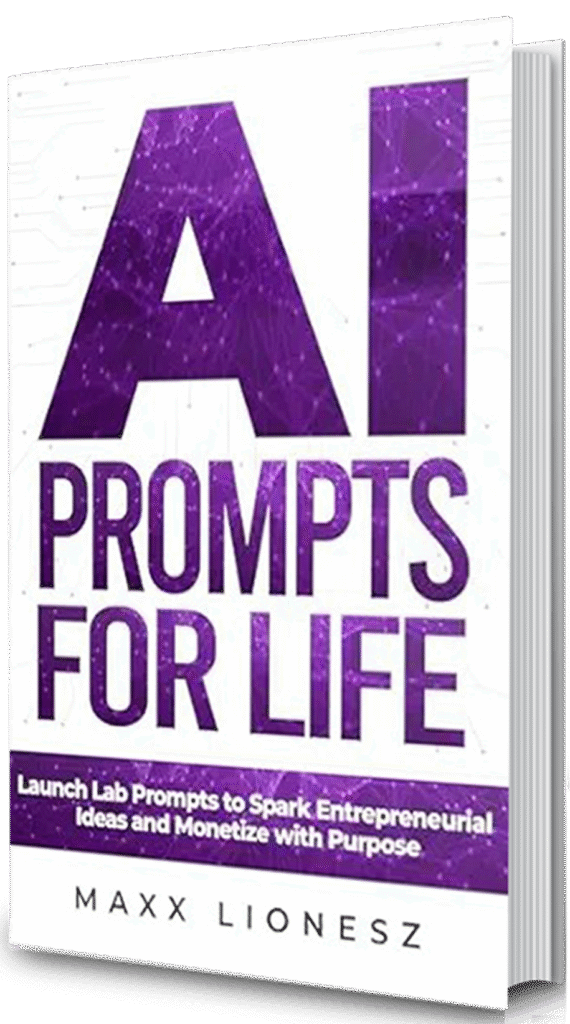
That is exactly the territory that AI Prompts for Life: Launch Lab Prompts to Spark Entrepreneurial Ideas and Monetize With Purpose by Maxx Lionesz was written to address. Built around the BE R.E.A.L. framework, the book gives entrepreneurs a structured, values-driven system for turning AI prompts into real business concepts, validated ideas, and sustainable income streams. Here are five of the most important things people miss when trying to monetize AI tools, and what to do differently.

1. AI Alone Is Not the Product

One of the most common misconceptions is assuming that adding AI to something automatically creates value. In practice, users tend not to pay for AI itself. They pay for outcomes.

People do not subscribe to an AI writing tool because it uses machine learning. They subscribe because it saves time, reduces friction, or helps them generate revenue. The same logic applies to AI image generators, chatbots, and analytics platforms.

Businesses that find traction with AI tools tend to position themselves around a specific, clear result. Rather than leading with the technology, they lead with the outcome:

  • We help businesses answer customer queries around the clock.
  • We reduce content creation time significantly for busy marketing teams.
  • We automate repetitive tasks so founders can focus on growth.


The technology enables those outcomes. But it is the outcome itself that earns the sale. If you cannot clearly articulate what problem you solve and for whom, the AI behind the product will not compensate for that gap.

2. Most Markets Are Already Crowded

Thousands of AI tools launch every month, and many are nearly identical in function. They differ mainly in branding or interface. This creates a competitive environment where broad, generic products often struggle to stand out, no matter how well-built they are.

What many founders underestimate is the power of niche positioning. Rather than building another general-purpose AI assistant, the businesses that tend to grow more sustainably focus on specific industries or well-defined use cases:

  • AI for legal document analysis
  • AI for real estate lead generation
  • AI for eCommerce product descriptions
  • AI for medical transcription

Niche tools often outperform broader competitors because they address specialized problems more directly, and their users feel genuinely understood. Positioning is not just a marketing decision. It is a product decision.

Try This Prompt in ChatGPT:

I want to build an AI-powered tool or service for [industry or audience]. Help me identify three underserved problems I could realistically solve, and suggest a positioning angle that sets me apart from generic AI competitors. Be specific about the pain points and the type of person who would pay for a solution.

3. Users Care About Workflow Integration

A capable AI tool can still fail to gain adoption if it disrupts how people already work. Many creators underestimate how resistant users are to changing their existing habits and tools.

Businesses already depend on platforms like Slack, Google Workspace, Shopify, Notion, and various CRMs. AI tools that fit naturally into those environments tend to have a much higher chance of adoption and monetization. Convenience and compatibility often matter more than novelty.

Instead of building a standalone platform that asks users to change their entire workflow, consider how your AI solution could enhance what people already use daily. The easier the integration, the lower the barrier to adoption.

4. Free Users Rarely Upgrade Without a Clear Reason

Offering a free plan is a common strategy, and it can work. But many AI businesses discover that free users stay free indefinitely, because they never encounter a strong enough reason to upgrade.

Effective monetization creates a meaningful and honest gap between free and paid tiers. Paid plans should unlock features that deliver clear business value, such as:

  • Faster processing for higher-volume users
  • Team collaboration and shared workspaces
  • Advanced analytics and reporting
  • Higher usage limits for professional workflows
  • Automation features that save meaningful time
  • Priority support for business-critical tasks

People pay when they genuinely believe the return outweighs the cost. That belief has to be built through real experience with the product, not just promised in the marketing.

Try This Prompt in ChatGPT:

I am building a freemium AI product for [describe your audience and what the tool does]. Help me design a feature ladder that gives free users a genuine taste of value but reserves business-critical capabilities for paid tiers. Suggest three to five specific features that would motivate a serious user to upgrade, and explain why each one matters to that audience.


5. Trust and Consistency Matter More Than Features

AI tools can produce inaccurate or inconsistent outputs. This creates hesitation, especially among businesses that depend on reliability for day-to-day operations.

Many founders concentrate heavily on expanding features while underinvesting in reliability, transparency, and support. Over time, long-term monetization tends to depend more on trust than on capability. Users want to know:

  • Can this tool produce consistent results I can depend on?
  • Is my data handled securely and responsibly?
  • Will support respond if something goes wrong?
  • Can I rely on this platform for tasks that affect my business?

A simpler, dependable AI product will often outperform a feature-heavy but inconsistent one. Building trust is not a feature. It is a foundation

How the BE R.E.A.L. Framework Strengthens AI Monetization

The five gaps above are not just tactical problems. They reflect a deeper issue: most people approach AI monetization without a clear framework for thinking, prompting, or executing. That is where the BE R.E.A.L. framework, developed by Maxx Lionesz, provides a genuine advantage.

BE R.E.A.L. stands for Royalty, Elegance, Assertiveness, Loyalty, and Financial Freedom. Each pillar shapes not just how you use AI tools, but how you build with them purposefully.

BE R.E.A.L. Pillar How It Shapes Your Monetization Prompts
Royalty Own your expertise. Prompt with the confidence of an industry authority, not a beginner asking for shortcuts.
Elegance Craft clear, specific prompts. Simple, focused language consistently produces more actionable AI output.
Assertiveness Direct the AI precisely. Tell it what you want, what format you need, and what to avoid.
Loyalty Keep your prompts aligned with your mission and values. Build an income stream you can sustain and believe in.
Financial Freedom Embed revenue goals into your prompt workflow. Every session should move you closer to a real business outcome.

When you apply the BE R.E.A.L. framework to your prompting and strategy sessions, AI stops being a random idea generator and starts functioning as a structured business development tool. Every prompt becomes intentional, and every output moves you closer to a real outcome.

Moving From AI Idea to Real Income

The barriers to monetizing AI tools are rarely technical. They are strategic, positional, and behavioral. The entrepreneurs who make meaningful progress tend to share a few things in common: they start with a specific problem worth solving, they test before they build, they build trust before they scale, and they treat AI as an accelerator for their thinking, not a replacement for it.

AI can help you identify your niche, sharpen your positioning, and draft your pitch. But validating that idea with real potential customers is still your responsibility. The tool speeds up the process. The entrepreneur does the work.
Ready to Turn AI Ideas into Real Opportunities?

Each of the five gaps covered in this article, from niche clarity to trust-building, is addressed directly inside AI Prompts for Life: Launch Lab Prompts to Spark Entrepreneurial Ideas and Monetize With Purpose by Maxx Lionesz.

The book is designed for entrepreneurs, freelancers, creators, and side hustlers who want to use AI with more intention and less guesswork. Instead of generic strategies, it gives you a hands-on prompt library, a step-by-step validation system, and the full BE R.E.A.L. framework to help you move from idea to execution with confidence.

Inside, you will find:

  • AI prompts designed to help you discover and validate a profitable niche
  • Frameworks for building a minimum viable offer before investing heavily
  • Practical monetization strategies for products, services, and content
  • Productivity systems to automate the repetitive work and protect your focus
  • Ethical AI guidance so your business is built on trust, not just technology

Whether you are launching your first AI-powered side hustle or expanding an existing business, this book gives you a structured path from prompt to profit.

Get your copy today and start building something real.

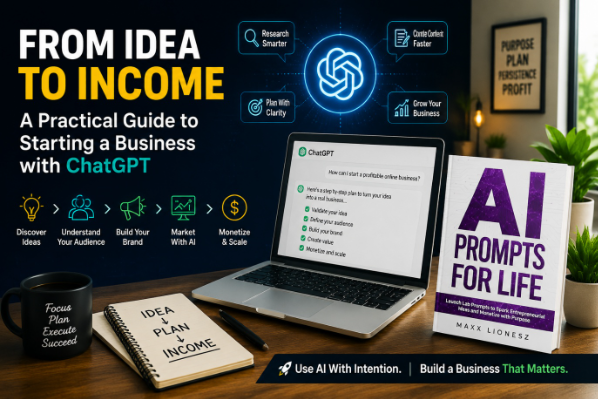
From Idea to Income: A Practical Guide to Starting a Business with ChatGPT

From Idea to Income: A Practical Guide to Starting a Business with ChatGPT

Artificial intelligence is changing the way many people start businesses. Tasks that once required a larger team or a bigger budget, like market research, content creation, and business planning, can now be approached more efficiently with tools like ChatGPT. Entrepreneurs at every stage are using AI to brainstorm ideas, test concepts, and build momentum faster than before.

Whether you want to launch an online business, freelance, sell digital products, or build a personal brand, AI can help reduce the learning curve when you know how to use it with intention. That is the critical part: the tool only works as well as the strategy behind it.

If you want a step-by-step roadmap to using AI for entrepreneurship, the book AI Prompts for Life: Launch Lab Prompts to Spark Entrepreneurial Ideas and Monetize With Purpose offers practical prompts, strategies, and real-world applications designed for aspiring entrepreneurs.

Step 1: Discover a Profitable Business Idea

Every successful business begins with solving a problem. But many people struggle to identify the right idea. This is where ChatGPT becomes a valuable brainstorming partner.

You can ask AI to:

  • Generate business ideas based on your skills
  • Analyze trending markets
  • Suggest profitable niches
  • Identify customer pain points

For example, someone passionate about fitness could explore online coaching, meal plans, or fitness content creation. A designer might create branding templates or offer digital services.

The ability to test and refine ideas quickly gives entrepreneurs a real advantage. Instead of spending weeks on manual research, AI can help accelerate the early discovery process, though validating those ideas still requires your own judgment and real-world testing.

The book AI Prompts for Life: Launch Lab Prompts to Spark Entrepreneurial Ideas and Monetize With Purpose includes actionable AI prompts specifically designed to help readers uncover profitable opportunities and turn creativity into income streams. Try this niche discovery prompt from the Launch Lab framework:

Example Prompt:

I have skills in [your skill, e.g., writing, design, coaching, fitness]. Using the BE R.E.A.L. framework, starting with Royalty (what I do best) and Loyalty (what aligns with my values), suggest five profitable niche business ideas I could realistically start, and explain the target audience and income potential for each.

Step 2: Understand Your Audience

A business succeeds when it understands its customers. Knowing what your audience wants helps you create products and services people are willing to pay for.

ChatGPT can help entrepreneurs:

  • Define target customers
  • Research buying behavior
  • Create customer personas
  • Identify market needs
  • Analyze competitors

When you understand your audience deeply, marketing becomes more focused and effective. AI can help structure that research, but the real insight still comes from listening to your market directly.  Try this audience research prompt from the Launch Lab framework

Example Prompt:

I want to start a business in [your niche]. Using the Elegance pillar of BE R.E.A.L., which means staying clear and focused, helps me build a simple customer profile. Who is my ideal customer, what problem do they have, and what kind of solution are they willing to pay for?

Step 3: Build a Strong Brand

Branding is what separates successful businesses from forgettable ones. Your business name, tone, messaging, and online presence all influence customer trust.

ChatGPT can assist with:

  • Business names
  • Slogans and taglines
  • Website copy
  • Social media bios
  • Brand storytelling

Solo entrepreneurs can use AI to build a more cohesive brand faster than before, without relying entirely on expensive agencies. The quality of the output still depends on the clarity of your direction and how much you refine the results.

For entrepreneurs who want ready-to-use prompts for branding, marketing, and business growth, AI Prompts for Life: Launch Lab Prompts to Spark Entrepreneurial Ideas and Monetize With Purpose serves as a practical guide to maximizing AI tools for business success.

Example Prompt:

Act as a brand strategist. I am launching a business called [name] that helps [target audience] with [core problem]. Using the Assertiveness pillar of BE R.E.A.L., help me write a brand positioning statement, a one-line tagline, and a short “about us” paragraph that is clear, confident, and aligned with my values.

Step 4: Use AI-Powered Marketing

Marketing is often one of the most difficult parts of starting a business. Fortunately, ChatGPT can help create high-quality content in less time.

Entrepreneurs can use AI to produce:

  • Blog posts
  • Product descriptions
  • Email campaigns
  • Social media captions
  • Video scripts
  • Advertising copy

Consistent content helps build visibility and trust over time. Instead of struggling with writer’s block or spending heavily on content creation, AI can help you draft, organize, and refine your messaging more efficiently, though your unique voice and real expertise still make the difference.  Try this marketing prompt from the Launch Lab framework:

Example Prompt:

I run a [type of business], and I want to grow my audience on [platform]. Help me create a 30-day content plan that includes educational posts, engagement prompts, and calls to action. Make sure the tone is [describe your voice] and aligns with my goal to [specific business outcome].

Step 5: Monetize and Scale Your Business

Once your business starts gaining traction, the next step is scaling sustainably. AI can support that growth, but it requires intentional use, not just automation for its own sake.

The Financial Freedom pillar of BE R.E.A.L. focuses on integrating income goals directly into your prompt strategy. This means using AI to map out your revenue streams, evaluate which offers are most scalable, and identify where automation can actually save you time. For example, you might use AI to build a digital product outline, draft an email sales sequence, or create a basic client onboarding workflow, then refine each piece based on what real customers actually respond to.

The key is to keep testing and iterating. AI is most powerful when you treat it as a collaborator in your growth process, not a shortcut around the hard work of building something real. Those who use it thoughtfully, combining AI efficiency with their own expertise and customer insight, tend to build businesses that last.  Try this monetization prompt from the Launch Lab framework:

Example Prompt:

I have a business in [niche], and I currently offer [product or service]. Using the Financial Freedom pillar of BE R.E.A.L., help me identify two or three ways I could add a scalable income stream, such as a digital product, a group offer, or a passive resource, without burning out. Include a simple next step for each idea.

The Future of Personal Growth Is More Interactive

The future of AI self-improvement is not about replacing coaches, therapists, mentors, journals, or personal responsibility. It is about making daily reflection more interactive and easier to apply. Instead of receiving generic advice, readers can use structured prompts to create a growth system that fits their actual lives.

When used responsibly, AI helps people move from information overload to focused action. It can support clarity, consistency, emotional awareness, and smarter daily decisions. The most important part is still the person using it: their honesty, their values, and their willingness to act.

Conclusion

Starting a business is more accessible than ever, and AI makes the early stages faster and more focused when you use it with a clear strategy. The five steps in this guide are a starting point, but the real progress comes from applying them, testing your ideas in the real world, and refining based on what actually works.

The BE R.E.A.L. framework, Royalty, Elegance, Assertiveness, Loyalty, and Financial Freedom, gives those steps a values-driven foundation. It keeps the process from becoming random experimentation and turns it into a repeatable system for building something meaningful.

If you’re ready to go deeper with a full prompt library, the BE R.E.A.L. framework in action, and real-world examples built for entrepreneurs like you, explore AI Prompts for Life: Launch Lab Prompts to Spark Entrepreneurial Ideas and Monetize With Purpose by Maxx Lionesz. Use it alongside ChatGPT, work through one step at a time, and start building your AI-powered business with purpose. Get your copy today. 

5 Options Trading Strategies Every Investor Should Master

5 Options Trading Strategies Every Investor Should Master

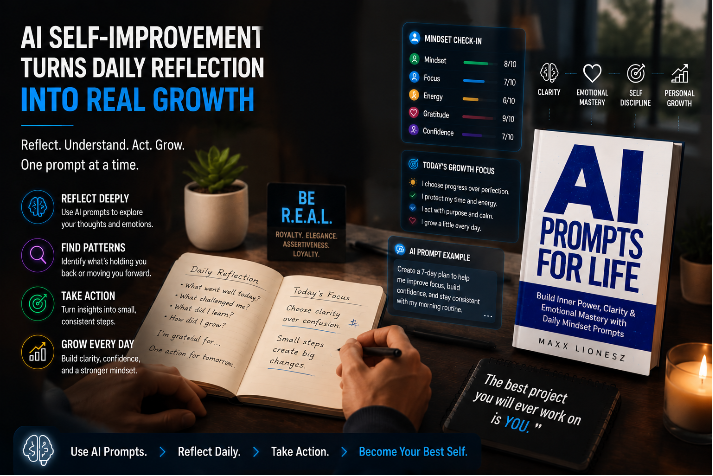
Personal growth has always started with one simple habit: honest reflection. From journaling and meditation to goal tracking and self-assessment, people have long searched for ways to better understand themselves and make better decisions. Today, AI self-improvement can make that process more focused, practical, and consistent.

Used intentionally, AI can act like a reflection partner. It can help you organize your thoughts, notice patterns you may miss, ask sharper questions, and turn vague ideas into clear action steps. The goal is not to replace human self-awareness. The goal is to support it with better structure, better prompts, and a repeatable system for growth.

That is the heart of AI Prompts for Life: Build Inner Power, Clarity & Emotional Mastery with Daily Mindset Prompts by Maxx Lionesz. The book is designed for readers who want practical daily prompts, not abstract inspiration. It shows how to use AI to build clarity, emotional balance, self-leadership, and consistent personal growth one prompt at a time

How AI Makes Reflection More Meaningful

Many people struggle with reflection because they either forget important details or never connect the dots between repeated behaviors. AI can help by giving structure to the reflection process. Instead of writing a few random thoughts and moving on, you can ask AI to help you identify recurring themes in your mood, energy, habits, decisions, and reactions.

For example, someone who journals regularly may not realize how often stress appears before missed workouts, late-night scrolling, or procrastination. With the right prompt, AI can help organize those observations into a clearer picture. That picture creates awareness, and awareness creates the opportunity for change.

Example Prompt: Review my reflections from this week and help me identify patterns in my mood, energy, focus, stress, and productivity. What recurring triggers or habits stand out, and what might they reveal about where I need more clarity or discipline?

Smarter Questions Lead to Deeper Insights

One reason AI can be useful for personal growth is that it can help you move beyond surface-level journaling. Instead of simply asking, “How was my day?” you can ask questions that reveal causes, choices, and opportunities for improvement.

  • What triggered my stress today?
  • Which habits supported my growth this week?
  • What conversations gave me energy, and which ones drained me?
  • Where did I avoid a decision that needed assertiveness?
  • What small action would help me feel more aligned tomorrow?

These questions help turn reflection into self-discovery. Instead of staying stuck in vague feelings, you begin to understand what is really influencing your mindset, energy, and results.

Turning Insights into Action

Reflection alone does not guarantee growth. Real improvement happens when insight becomes action. This is where AI self-improvement becomes especially valuable: it can help you turn a pattern into a plan.

For example, if your reflections show that you lose focus every afternoon, AI can help you design a seven-day focus reset. If you notice that difficult conversations create anxiety, AI can help you rehearse a calmer, more assertive response. If you feel stuck in negative self-talk, AI can help you create a daily self-leadership prompt routine.

Example Prompt: Create a 7-day personal growth plan to help me improve focus, build confidence, and stay consistent with my morning routine. Include one small action, one reflection question, and one accountability check for each day.

The key is to treat AI as a practical tool for action, not a shortcut around effort. AI can suggest routines, but you still have to show up. AI can help you clarify choices, but you still have to make them. That balance keeps the process human, grounded, and effective.

Emotional Mastery Through Awareness

Another powerful use of AI self-improvement is emotional awareness. AI can help you name what you are feeling, explore why it may be happening, and consider how your emotions are influencing your choices.

This does not mean outsourcing your emotions to technology. It means using technology as a mirror. When you write honestly and prompt carefully, AI can help you slow down, interpret your emotional patterns, and respond with more clarity.

The goal is not to suppress emotions. The goal is emotional mastery: understanding what you feel, why it matters, and how to act in a way that aligns with your values.

Example Prompt: Help me understand how my emotions affected my decisions this week. Identify where I reacted from stress, fear, or frustration, and suggest how I can respond with more clarity and self-leadership next time.

How the BE R.E.A.L. Framework Makes AI Reflection More Practical

Maxx Lionesz’s BE R.E.A.L. framework gives AI reflection a stronger foundation because it ties daily prompts to values, behavior, and real-world action. The framework keeps the process from becoming random journaling or generic self-help advice.

BE R.E.A.L. Pillar

How to Use It in AI Self-Improvement

Royalty

Lead yourself with purpose. Ask AI to help clarify your values, vision, and next best decision.

Elegance

Simplify your habits and emotional responses. Ask AI to help you choose calm, clear, sustainable actions.

Assertiveness

Protect your time, energy, and boundaries. Ask AI to help rehearse difficult conversations or decisions.

Loyalty

Stay consistent with your goals and future self. Ask AI to create check-ins, progress reviews, and accountability prompts.

Example Prompt: Act as a self-mastery coach. Guide me through a BE R.E.A.L. check-in today: Royalty – How did I lead myself with integrity? Elegance – Where can I simplify my habits? Assertiveness – Where do I need better boundaries? Loyalty – How did I stay aligned with my values? End with three actions I can take now.

The Future of Personal Growth Is More Interactive

The future of AI self-improvement is not about replacing coaches, therapists, mentors, journals, or personal responsibility. It is about making daily reflection more interactive and easier to apply. Instead of receiving generic advice, readers can use structured prompts to create a growth system that fits their actual lives.

When used responsibly, AI helps people move from information overload to focused action. It can support clarity, consistency, emotional awareness, and smarter daily decisions. The most important part is still the person using it: their honesty, their values, and their willingness to act.

Ready to Build Inner Power, Clarity, and Emotional Mastery?

If you want to take your AI-powered self-improvement journey further, read AI Prompts for Life: Build Inner Power, Clarity & Emotional Mastery with Daily Mindset Prompts by Maxx Lionesz.

Whether you want more mental clarity, stronger emotional resilience, better boundaries, or a more consistent personal growth routine, this practical guide gives you daily prompts and a simple framework to help you reflect smarter, act with confidence, and build habits that support the person you are becoming.

Use it with ChatGPT or your favorite AI tool, pause after each prompt, and turn reflection into real progress one day at a time.

Get your copy today and start building a clearer, stronger, more intentional version of yourself.

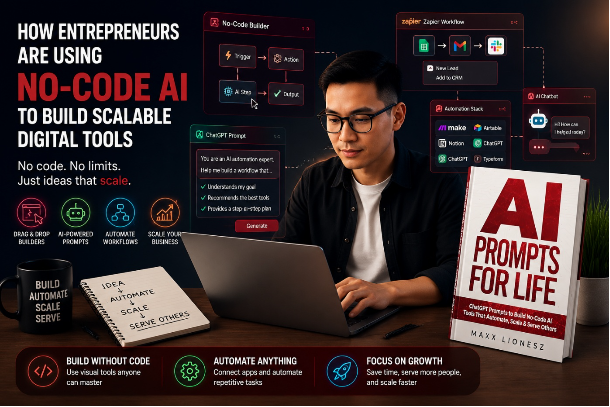
How Entrepreneurs Are Using No-Code AI to Build Scalable Digital Tools

How Entrepreneurs Are Using No-Code AI to Build Scalable Digital Tools

For many entrepreneurs, that used to be the biggest barrier between an idea and a working product. Today, no-code AI is helping change that equation. With AI-assisted platforms and well-crafted prompts, founders can build workflows, chatbots, automation systems, and digital tools without writing a single line of code.


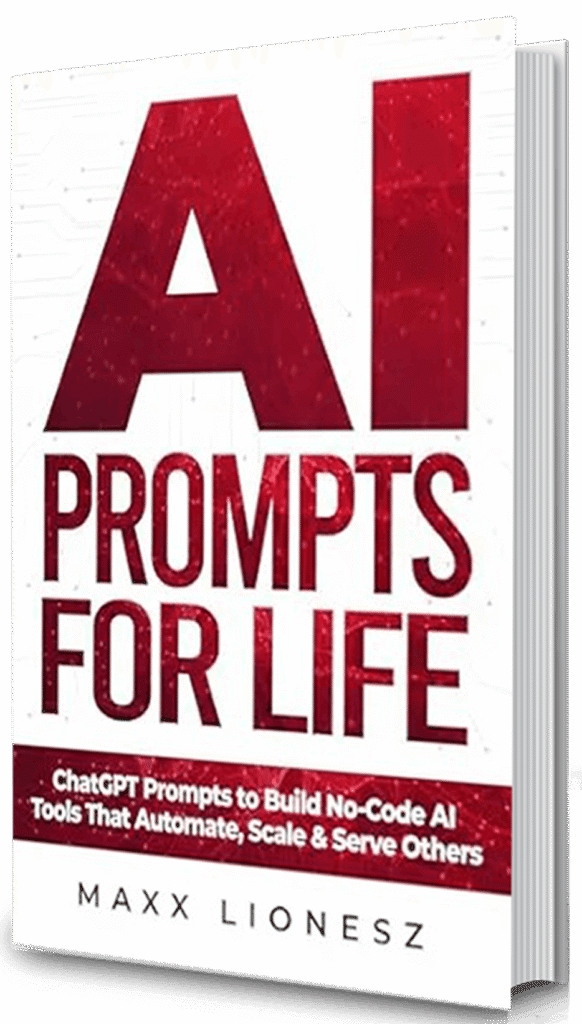
That is exactly what Maxx Lionesz explores in AI Prompts for Life: ChatGPT Prompts to Build No-Code AI Tools That Automate, Scale & Serve Others. The book is a practical guide for non-technical entrepreneurs who want to use ChatGPT to create real, working tools, not just experiment with AI for fun. This article draws from that framework to show how no-code AI works in practice and what it takes to build with it successfully.

What Is No-Code AI?

No-code AI refers to platforms that combine artificial intelligence with visual development environments. Instead of writing complex code, users create applications, workflows, and digital tools through drag-and-drop builders, AI-assisted commands, and pre-built integrations.

Common no-code AI tools include Zapier, Make (formerly Integromat), Airtable, Notion, and ChatGPT. Each one handles a different layer of your automation stack, and when combined with the right prompts, they can power everything from lead capture systems to content workflows to client onboarding sequences.

The important distinction: no-code AI is not a magic button. It is a toolkit that rewards clarity, structure, and good prompt design. The better your prompts, the better your results.

Example Prompt: You are a no-code automation specialist. I run a [type of business] and want to automate [specific task]. Recommend the best combination of no-code tools to handle this, explain how each tool fits together, and give me a step-by-step setup plan I can follow without technical experience.

Faster Product Development for Startups

One of the most practical advantages of no-code AI is the ability to move faster. Entrepreneurs who once waited weeks for a developer to build a prototype can now test ideas in days.

For example, a founder building a booking tool can use no-code platforms to design an interface, automate client notifications, and integrate a payment system, all through visual tools and AI-generated prompts. This does not eliminate the need for strategy or testing. It just removes the technical bottleneck that used to slow everything down.


In AI Prompts for Life, Lionesz introduces the concept of the Prompt Recipe Card: a structured template with a role, task, context, and output format. Applied to product development, this approach helps entrepreneurs generate functional first drafts of workflows, onboarding sequences, and user experiences in a fraction of the usual time.

Example Prompt: Act as a product development assistant. I am building a [type of digital tool] for [target audience]. Create a step-by-step prototype plan using no-code AI tools. Include the platforms I should use, the prompts I can use to set them up, and how to test each step before going live.

Automating Business Operations

Many entrepreneurs use no-code AI to reduce the time spent on repetitive tasks. Platforms like Zapier and Make can connect apps and trigger actions automatically, moving data, sending messages, and updating records without manual effort.


Common use cases include automated lead follow-ups, client onboarding email sequences, FAQ chatbots, scheduling workflows, and weekly reporting systems. These are not futuristic concepts. They are practical automations that business owners are running today, built on a foundation of clear prompts and modular no-code setups.


The key insight from Lionesz’s BE R.E.A.L. framework is that automation should serve people, not just save time. Loyalty means designing workflows that feel personal and intentional, not robotic. A well-crafted follow-up prompt does not just automate a message, it delivers the right tone, the right offer, and the right next step for that specific customer.

Example Prompt: You are my company’s customer support specialist. A new client just signed up. Write a three-part onboarding email sequence that welcomes them warmly, explains what to expect in their first week, answers the three most common questions, and ends with a clear next action. Keep the tone professional but human.

Empowering Non-Technical Founders

Traditionally, non-technical entrepreneurs depended on developers for almost every digital task. No-code AI has opened up more options, but it still requires effort, experimentation, and a willingness to iterate.

What changes with no-code AI is not the need for skill, but the type of skill required. Instead of learning to code, entrepreneurs learn to prompt. They learn to define roles clearly, provide context, and structure their asks in ways that produce reliable, useful outputs.

Lionesz addresses this directly in the book with a concept he calls “prompt paralysis,” the hesitation that comes from not knowing where to start. His solution is simple: use a fill-in-the-blank framework. Once you have your first working prompt, you have a foundation to build from. Every improvement builds confidence and capability.

Royalty, in the BE R.E.A.L. framework, means taking ownership of your tools. Non-technical founders who treat no-code AI as something they actively design and refine, rather than something that runs on autopilot, consistently get better results.

The Future of Scalable Digital Innovation

No-code AI is not a silver bullet, but it is becoming a meaningful part of how entrepreneurs build and scale. As the tools improve, so does what is possible for someone without a technical background.

The entrepreneurs who will benefit most are not necessarily the ones who adopt every new tool. They are the ones who learn to prompt well, test consistently, and build modular systems they can improve over time. That is the “stackable recipe card” approach Lionesz outlines: start small, build one automation at a time, and expand as your confidence grows.

Conclusion

Entrepreneurs no longer need deep technical expertise to build useful digital tools. With no-code AI platforms and well-designed prompts, innovative ideas can become working systems that serve real people. But the tools are only as good as the thinking behind them.

What makes the difference is a clear framework, intentional design, and a commitment to iteration. That is exactly what AI Prompts for Life provides: a practical, prompt-first approach to building no-code AI tools that automate, scale, and serve others.

Ready to Build, Automate, and Grow Smarter with No-Code AI?

If you want to go beyond surface-level AI use and learn how to create prompts that actually build things, workflows, tools, onboarding systems, and content machines, then AI Prompts for Life: ChatGPT Prompts to Build No-Code AI Tools That Automate, Scale & Serve Others by Maxx Lionesz is the practical guide you need.

This book is designed for entrepreneurs, freelancers, creators, marketers, and professionals who want to use ChatGPT to build no-code AI tools that solve real problems. Inside, you’ll find the BE R.E.A.L. framework, plug-and-play Prompt Recipe Cards, integration blueprints for tools like Zapier, Airtable, and Notion, and step-by-step guidance for building your first AI-powered workflow from scratch.

Whether you are launching a no-code product, automating a service-based business, or simply trying to work more efficiently, this book gives you the prompts and the process to make it happen.


Get your copy today and start building tools that automate, scale, and serve others.