
How Entrepreneurs Are Using No-Code AI to Build Scalable Digital Tools
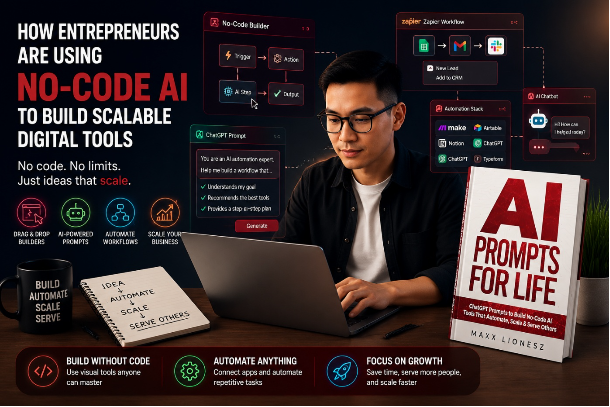
For many entrepreneurs, that used to be the biggest barrier between an idea and a working product. Today, no-code AI is helping change that equation. With AI-assisted platforms and well-crafted prompts, founders can build workflows, chatbots, automation systems, and digital tools without writing a single line of code.
That is exactly what Maxx Lionesz explores in AI Prompts for Life: ChatGPT Prompts to Build No-Code AI Tools That Automate, Scale & Serve Others. The book is a practical guide for non-technical entrepreneurs who want to use ChatGPT to create real, working tools, not just experiment with AI for fun. This article draws from that framework to show how no-code AI works in practice and what it takes to build with it successfully.
What Is No-Code AI?
No-code AI refers to platforms that combine artificial intelligence with visual development environments. Instead of writing complex code, users create applications, workflows, and digital tools through drag-and-drop builders, AI-assisted commands, and pre-built integrations.
Common no-code AI tools include Zapier, Make (formerly Integromat), Airtable, Notion, and ChatGPT. Each one handles a different layer of your automation stack, and when combined with the right prompts, they can power everything from lead capture systems to content workflows to client onboarding sequences.
The important distinction: no-code AI is not a magic button. It is a toolkit that rewards clarity, structure, and good prompt design. The better your prompts, the better your results.
Example Prompt: You are a no-code automation specialist. I run a [type of business] and want to automate [specific task]. Recommend the best combination of no-code tools to handle this, explain how each tool fits together, and give me a step-by-step setup plan I can follow without technical experience.
Faster Product Development for Startups
One of the most practical advantages of no-code AI is the ability to move faster. Entrepreneurs who once waited weeks for a developer to build a prototype can now test ideas in days.
For example, a founder building a booking tool can use no-code platforms to design an interface, automate client notifications, and integrate a payment system, all through visual tools and AI-generated prompts. This does not eliminate the need for strategy or testing. It just removes the technical bottleneck that used to slow everything down.
In AI Prompts for Life, Lionesz introduces the concept of the Prompt Recipe Card: a structured template with a role, task, context, and output format. Applied to product development, this approach helps entrepreneurs generate functional first drafts of workflows, onboarding sequences, and user experiences in a fraction of the usual time.
Example Prompt: Act as a product development assistant. I am building a [type of digital tool] for [target audience]. Create a step-by-step prototype plan using no-code AI tools. Include the platforms I should use, the prompts I can use to set them up, and how to test each step before going live.
Automating Business Operations
Many entrepreneurs use no-code AI to reduce the time spent on repetitive tasks. Platforms like Zapier and Make can connect apps and trigger actions automatically, moving data, sending messages, and updating records without manual effort.
Common use cases include automated lead follow-ups, client onboarding email sequences, FAQ chatbots, scheduling workflows, and weekly reporting systems. These are not futuristic concepts. They are practical automations that business owners are running today, built on a foundation of clear prompts and modular no-code setups.
The key insight from Lionesz’s BE R.E.A.L. framework is that automation should serve people, not just save time. Loyalty means designing workflows that feel personal and intentional, not robotic. A well-crafted follow-up prompt does not just automate a message, it delivers the right tone, the right offer, and the right next step for that specific customer.
Example Prompt: You are my company’s customer support specialist. A new client just signed up. Write a three-part onboarding email sequence that welcomes them warmly, explains what to expect in their first week, answers the three most common questions, and ends with a clear next action. Keep the tone professional but human.
Empowering Non-Technical Founders
Traditionally, non-technical entrepreneurs depended on developers for almost every digital task. No-code AI has opened up more options, but it still requires effort, experimentation, and a willingness to iterate.
What changes with no-code AI is not the need for skill, but the type of skill required. Instead of learning to code, entrepreneurs learn to prompt. They learn to define roles clearly, provide context, and structure their asks in ways that produce reliable, useful outputs.
Lionesz addresses this directly in the book with a concept he calls “prompt paralysis,” the hesitation that comes from not knowing where to start. His solution is simple: use a fill-in-the-blank framework. Once you have your first working prompt, you have a foundation to build from. Every improvement builds confidence and capability.
Royalty, in the BE R.E.A.L. framework, means taking ownership of your tools. Non-technical founders who treat no-code AI as something they actively design and refine, rather than something that runs on autopilot, consistently get better results.
The Future of Scalable Digital Innovation
No-code AI is not a silver bullet, but it is becoming a meaningful part of how entrepreneurs build and scale. As the tools improve, so does what is possible for someone without a technical background.
The entrepreneurs who will benefit most are not necessarily the ones who adopt every new tool. They are the ones who learn to prompt well, test consistently, and build modular systems they can improve over time. That is the “stackable recipe card” approach Lionesz outlines: start small, build one automation at a time, and expand as your confidence grows.
Conclusion
Entrepreneurs no longer need deep technical expertise to build useful digital tools. With no-code AI platforms and well-designed prompts, innovative ideas can become working systems that serve real people. But the tools are only as good as the thinking behind them.
What makes the difference is a clear framework, intentional design, and a commitment to iteration. That is exactly what AI Prompts for Life provides: a practical, prompt-first approach to building no-code AI tools that automate, scale, and serve others.
Ready to Build, Automate, and Grow Smarter with No-Code AI?
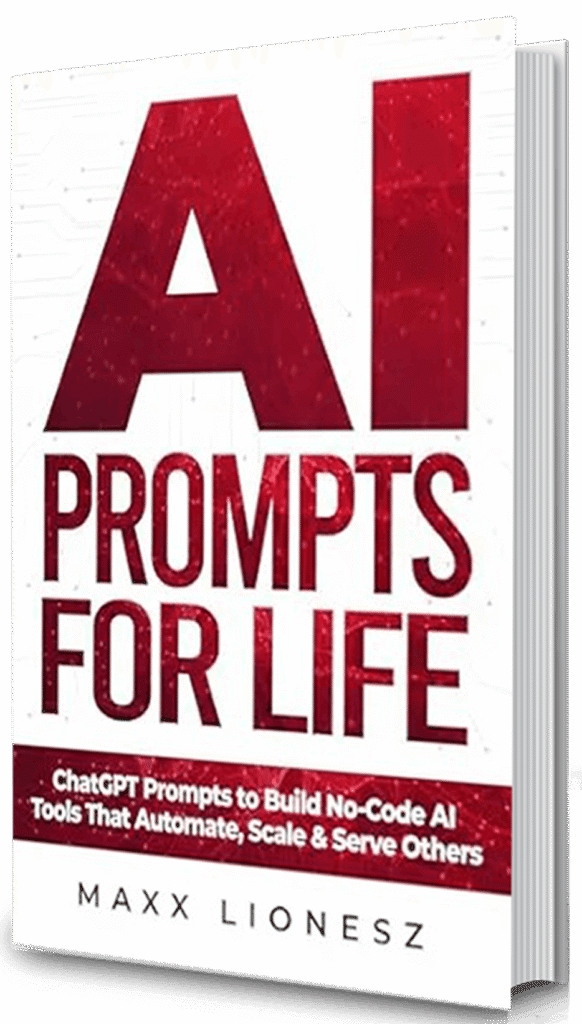
If you want to go beyond surface-level AI use and learn how to create prompts that actually build things, workflows, tools, onboarding systems, and content machines, then AI Prompts for Life: ChatGPT Prompts to Build No-Code AI Tools That Automate, Scale & Serve Others by Maxx Lionesz is the practical guide you need.
This book is designed for entrepreneurs, freelancers, creators, marketers, and professionals who want to use ChatGPT to build no-code AI tools that solve real problems. Inside, you’ll find the BE R.E.A.L. framework, plug-and-play Prompt Recipe Cards, integration blueprints for tools like Zapier, Airtable, and Notion, and step-by-step guidance for building your first AI-powered workflow from scratch.
Whether you are launching a no-code product, automating a service-based business, or simply trying to work more efficiently, this book gives you the prompts and the process to make it happen.
Get your copy today and start building tools that automate, scale, and serve others.